Digital Community Gardens
Beta release Jan 2027
A blueprint for community-led AI and civic engagement
Community-Led AI
A small number of powerful institutions shape which narratives AI models promote, where data centers are built, and who can access and steer these tools. Communities need shared knowledge and ways to organize so they can shape AI infrastructure, data ownership, and technology in their classrooms, homes, and public spaces.
The Community Digital Garden is a civic platform seeded by artists and shaped by residents. Artists co-create the installations and prompts; residents share stories, find common concerns, and set the agenda for working groups that engage city leaders.
The Need
The Phoenix metro is one of the fastest-growing data center hubs in the country. Decisions about where data centers are built, how much water they consume, and what they return to surrounding communities are made without the residents who live with those consequences. Residents share concerns about these changes but lack the infrastructure to find each other, recognize shared concerns, or arrive at city negotiations as an organized group.
Collect Personal Narratives
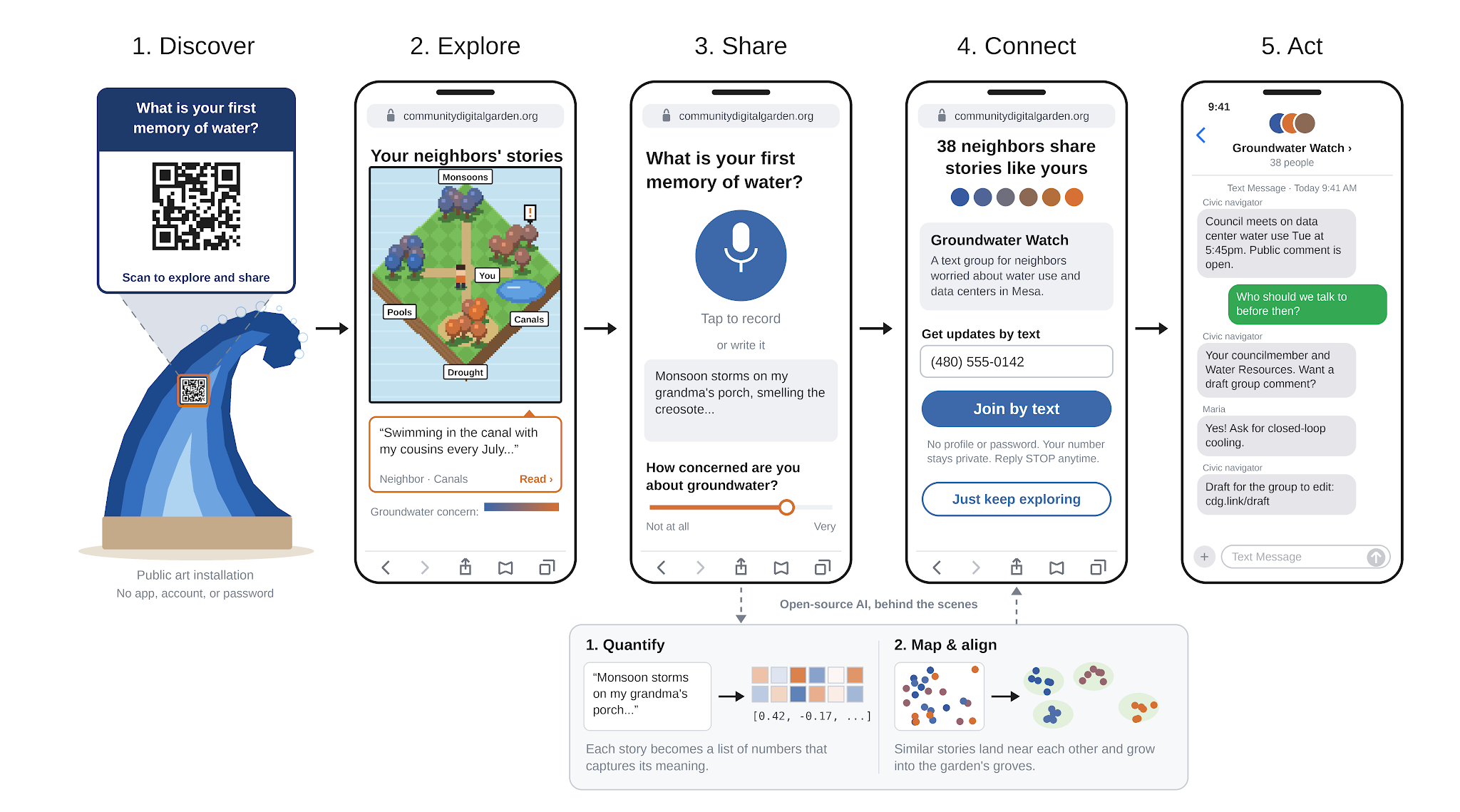
Physical installations, co-designed with Arizona artists and community members, are placed in high-traffic public spaces: light rail stops, library entrances, downtown plazas. Each installation is place-specific. Each carries a QR code. Artists and community members will determine what object best tells the story of each neighborhood.
A resident scans the code. A prompt asks for a personal memory: their first memory of water, or a place in the neighborhood that has changed. They respond by voice or text. No app download is required. All entries are anonymous by default.
Connect Residents Through the Digital Garden
Open-source AI models transcribe residents’ stories and arrange them into an explorable landscape, clustering stories by their emotions, characters, and content. Themes emerge from residents’ own language, not from researcher-defined categories.
Stories are organized by shared understanding. A resident sees where their memory sits among others’, which concerns are widely shared, and which neighbors hold similar views. This alignment is the basis for connection. Residents can create a public or private profile, find others whose stories and concerns resemble their own, and join groups organized around shared issues.
For the research behind extracting and connecting beliefs from residents’ narratives, see my AI pipeline for modeling causal beliefs from natural language, which identifies cause-and-effect claims and groups them into networks of related topics.
Equip Residents to Act
The platform includes a civic AI navigator built on open-source models (Llama 3 or Mistral) using a retrieval-augmented generation pipeline. The navigator helps residents understand how specific decisions get made, which public meetings or comment periods are relevant, and which officials, agencies, or developers to contact. It helps residents draft communications in their own voice. It does not speak for residents. It gives them the knowledge to speak for themselves.
Working groups form around shared concerns surfaced through the garden. Members coordinate meetings, share materials, and build toward collective action. The platform actively moves connections offline: residents meet in homes, cafes, and community spaces.
A working group concerned about data center water use can identify who oversees data center permitting in Mesa, understand the public comment process, and draft a communication demanding closed-loop cooling systems or profit-sharing arrangements that return resources to the community: shade infrastructure, bike lanes, after-school technology programs. They arrive at that meeting as an organized constituency, not as isolated individuals.
A Blueprint for Community-Led AI
The platform, public data, and community model developed in Mesa will be documented and released as an open resource for other communities navigating the rapid growth of AI infrastructure.
Community organizations can also use frontier AI to support local research networks that develop technology products meeting the needs of people in their neighborhoods.
The psychological motivation for this community-led approach is developed in How Artificial Intelligence Shapes Human Narratives, where I discuss how local-first AI can help communities shape technology around their own needs.